I had been trying to find connections between my bees and two events that have caused major disruptions in my life lately. Those events being the pandemic spread of coronavirus, which is turning the world upside-down for millions amid fears and uncertainty, and a total hip replacement, which has paused my normally active routines but without the fear and uncertainty created by a pandemic.
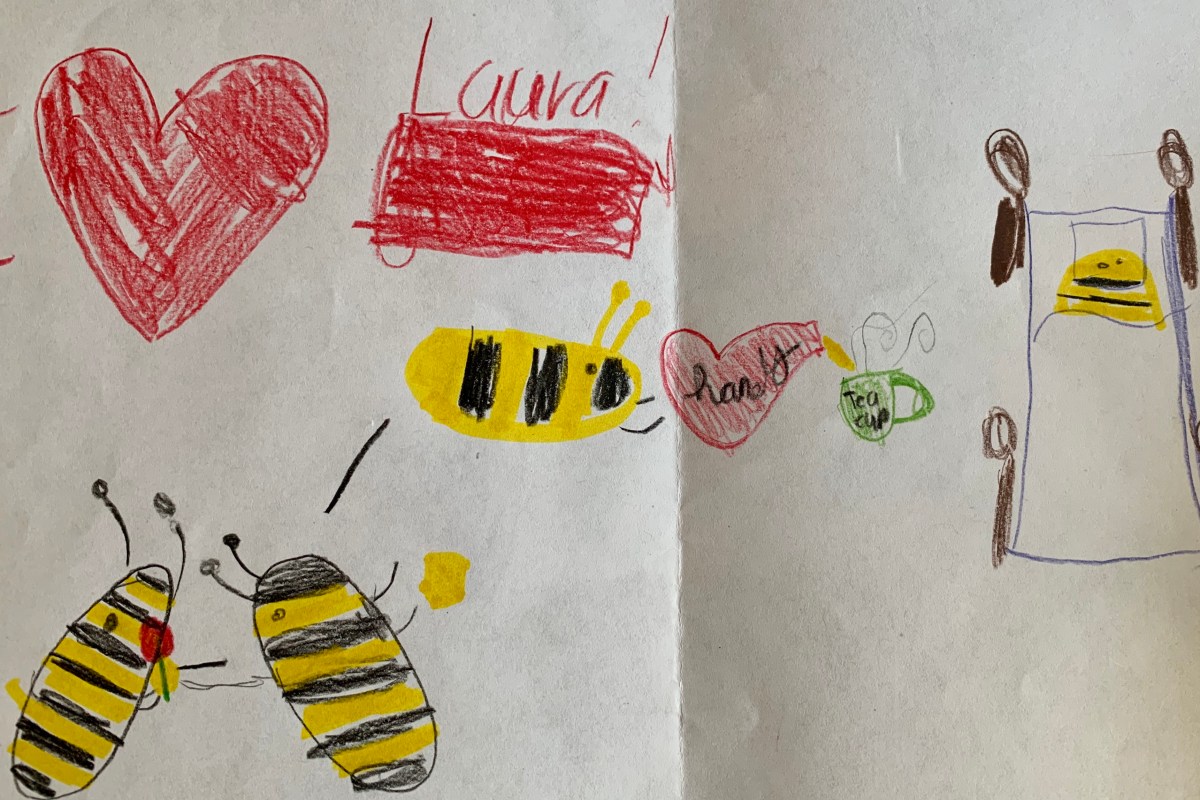
The connection was made in a get-well card from my granddaughter. She said she loved me (grandmas love to hear that!) and then she drew a picture of my bees taking care of a sick bee. One was pouring her a cup of honey tea (hot water + honey, a grandkid favorite) and another was licking a red lollipop.
Honey bees do self-isolate when one of them is ill. Rather than infecting the whole hive, sick bees often will leave the hive. This minimizes the spread of any infectious disease and secures the future of a healthy hive. Of course, such quarantines do not bode well for those sick bees – they eventually die.
I have heard about research that examines behavioral changes in bees that may be caused by certain viruses. A particular virus appears to actually reverse a sick bee’s self-isolation response. The virus may even create a smell that attracts other bees to the sick bee, thus assuring the continuation (and spread) of the virus.
This is scary, not unlike the fear and uncertainty being generated by the novel coronavirus. Wr do not know what to expect; this is all new ground we are navigating.
In scary times, we are called to have more compassion, something else that I have observed in my bee hives. Each spring, one of the first jobs of worker bees is to clear out all the bees that have died over the past winter. It usually take several bees to drag out a dead bee. And you’ll find the dead bees piled neatly in front of the hive.
We also need to have compassion for the more vulnerable folks during this pandemic. No matter my fears, there are many others who have an underlying health condition or fewer resources, and thus more reason to fear future what-ifs. Yes, we need to self-isolate (or social distance), but we also need to create ways to offer help and resources to others during these uncertain times.
I’ve also read that the bees share everything they have with the rest of the hive. In winter temperatures they come together in a cluster, shaking their bodies to keep a minimum temperature for the queen in the middle of the cluster. They also take turns being on the outside of the cluster where it’s the coldest.
I really liked my granddaughter’s drawing of the bees caring for each other. It reminded me that after my hip surgery I am not alone, that there’s a hive full of people who care for me, and will help me navigate the next few confusing weeks as I heal and get used to my new hip.
Food stores are readily shared, too. The bees closest to the capped honey pass it along to their sisters. Starvation strikes the entire hive and not just the ones farthest from the food.
I am thankful that thousands and thousands of people have had the same surgery as I have. My doctor has a good protocol for me to follow. Although I have never experienced this surgery, I can trust that the outcome will be good, minimizing my fear.
I hope you can practice compassion as we plod through the pandemic. And as always, love those bees!!
 Bee Lady Honey
Great writing, as usual!
LikeLike
Thanks! I am thankful for my bees and my family and friends.
LikeLike
Hi Laura, love you post. In spite of everything 7 of us are still running the food bank on Tue & Wed morning. We had 85 families last week, 50 this week. All of us are doing it because we feel better doing something. We are trying to be sensible and not take too many risks, it’s “grab & go” so no interaction with the families. We miss them. Paul & I hope your hip heals quickly and all is well for you and yours! Fondly, Pam
LikeLiked by 1 person
So good to hear from you! Our food pantry is doing the sane thing. I would be helping, too, if able. Am anxious to garden again.
LikeLike