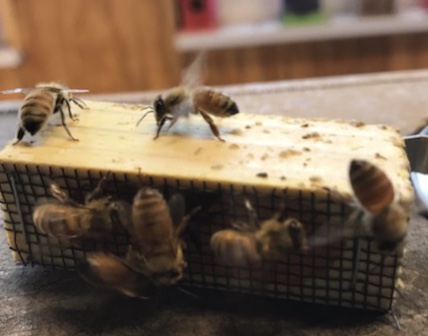
Today is Bee Day! No, it’s not anyone’s birthday, unless you consider the 20,000 new bees taking up residence on our acreage to be the birth of two new bee colonies.
We bought two packages of honey bees from Spring Valley Honey just west of Perry. These bees are back in Iowa, having spent the winter in California pollinating almond trees. We hope they’re ready to work over the dandelions that are blooming in our yard.
Each “package” is contained in a wood-and-wire box the size of a very large bread box. In the top of the box is a hole where a metal can full of sugar syrup is inserted. The bees, all 10,000 of them, excitedly crawled and buzzed and explored every inch of the container. Not one of them was still for a second. A squirt of sugar water calms them for just a bit.
Each package came with a queen bee, also ready to go. She was suspended from the roof of the box in a small wooden capsule about the size of a lipstick tube. Her cage was covered with attendant bees, attracted by her pheromone smells, who were eager to offer her food and water.
Installing the bees is pretty simple. We already had a deep box of 10 frames set up on a cement pad in our yard. The trickiest part may be replacing the cork in the queen cage with a piece of candy in a small tube. Of course, the hive bees eat the candy in the tube, which releases the queen. The process takes about 2-3 days, long enough for the bees to get used to the queen and her pheromones. If we simply released the queen she would be killed by the hive bees.
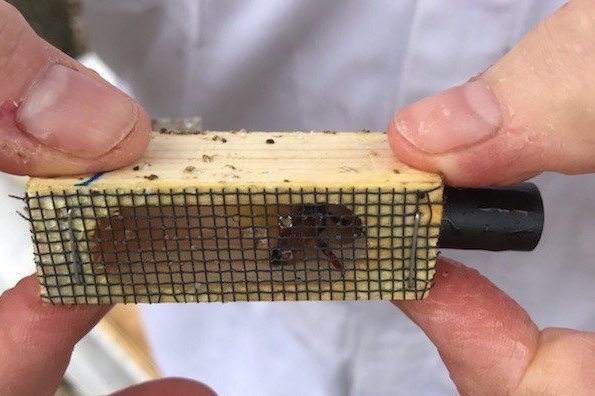
The queen cage is attached to the top of a middle frame in the hive box. The bees must be able to feed the queen through the wire screen, and get to the candy in the tube.
Getting the bees out of the wood box is not as difficult as it might seem. They actually pour out like sand. A few shakes and most of the bees get the general idea. Plus, their new digs are much more interesting than a wood box.
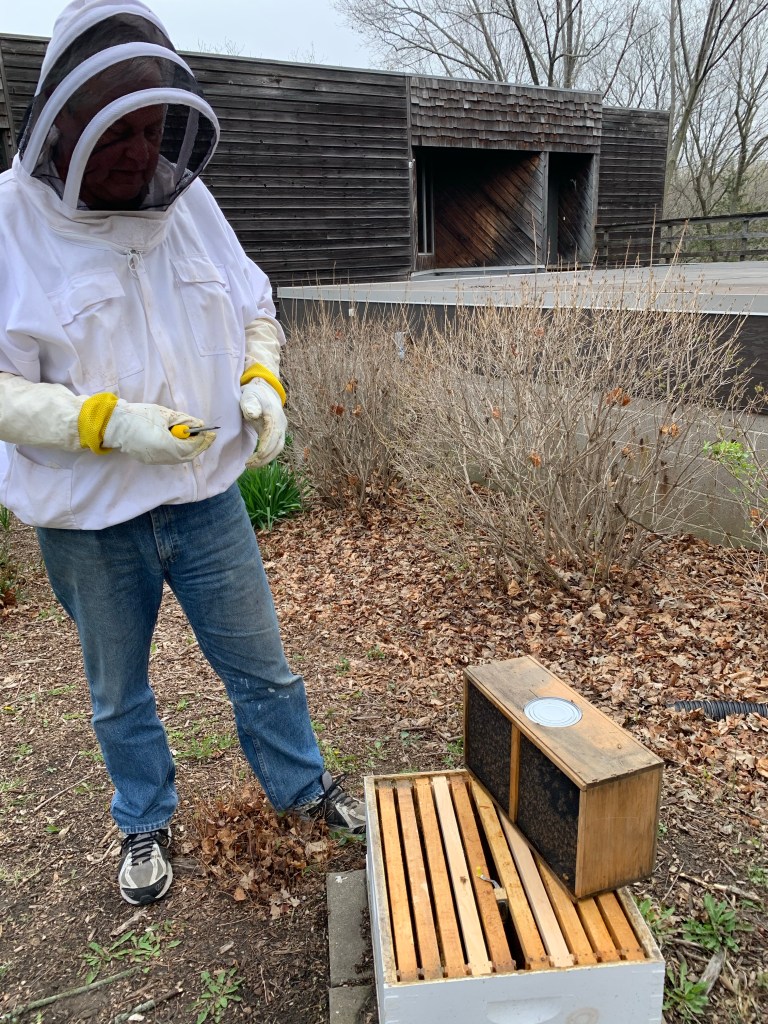
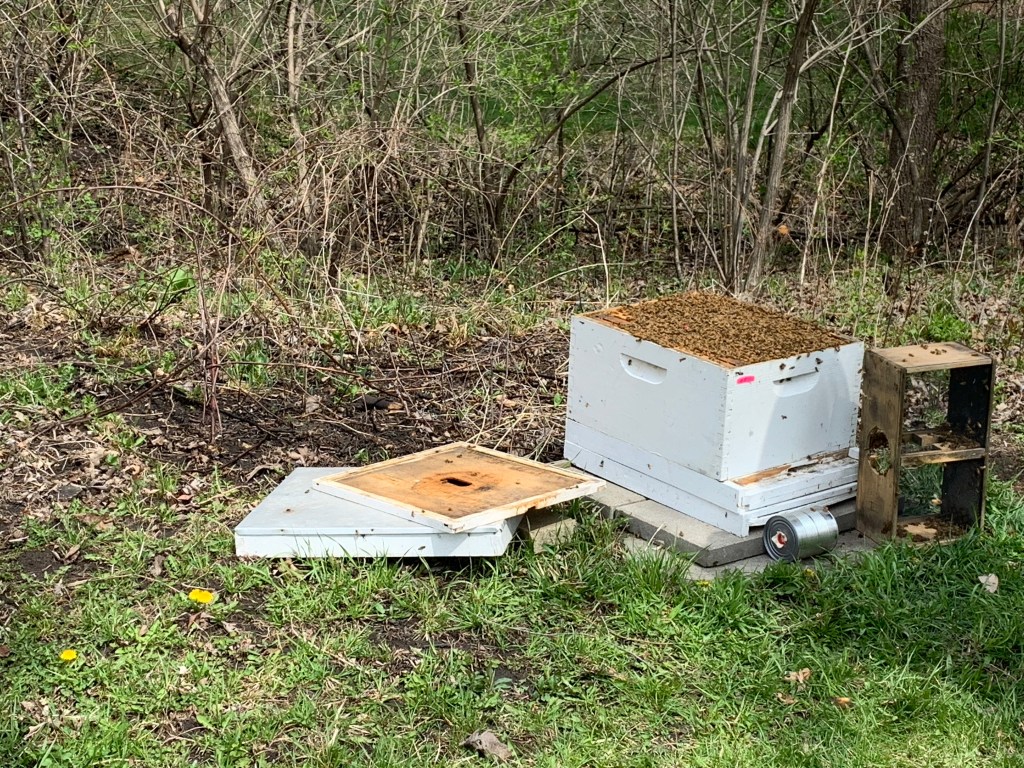
It takes only about 10 minutes for the bees to settle into the hive. A few are flying around, checking out their new surroundings.
Now we leave them alone. It’s important to not disturb the new colony for 3 to 5 days. We’ll check to make sure the queen is out of the cage. If all goes according to plan, we’ll see eggs and new comb and foragers bringing in nectar and pollen. Eventually, we’ll give them a second deep box for brood and honey stores.
Welcome, new bees! We hope you like it here!
 Bee Lady Honey