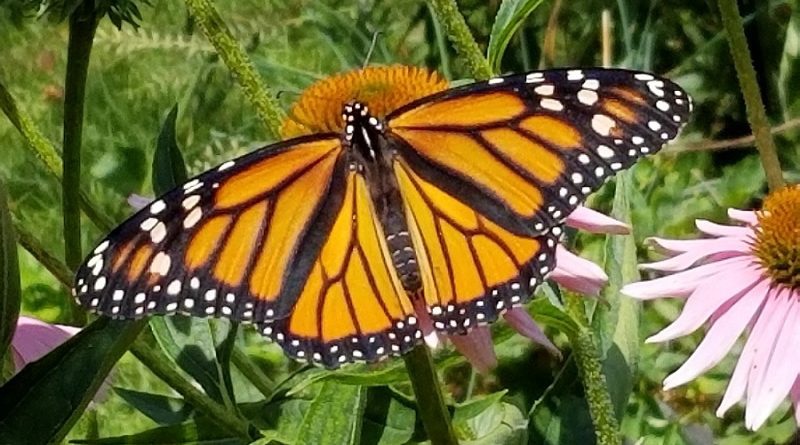
Apocalypse: An event involving destruction or damage on an awesome or catastrophic scale.
I do not use that word lightly, but it may be the most accurate way to describe what’s happening this year with one of our favorite insects, next to the honey bee: the Monarch butterfly.
Various groups have made it their business to conduct scientific counts of the overwintering populations of both the eastern Monarch butterfly, which breeds each of the Rockies, including Iowa, and migrates to the Sierra Madre mountains in central Mexico, and the western Monarch butterfly, which breeds west of the Rockies and roosts in southern California.
In my lifetime, these darlings of the insect world once numbered in the millions if not billions. Today’s population estimates are nothing short of heart-stopping.
Here are the sad facts:
Eastern Monarch
- Overwintering butterflies covered approximately 7 acres of forest canopy in Mexico, less than half the area of last year’s population. Scientists estimate a long-term average of 15 acres of occupied forest canopy is needed to sustain the population.
- Decline in the past 20 years: 80 percent
Western Monarch
- Fewer than 30,000 butterflies were found at more than 400 sites, possibly a critical point for survival of the species. This is the second consecutive year the count was below the critical threshold.
- Decline in the past 20 years: 99 percent.
Can they bounce back? Scientists worry that they may not. A major threat to the Monarch is loss of habitat. Monarchs are the only known butterfly to make a two-way migration, similar to birds, though their migration happens over the course of several generations. Along this migratory route, they choose specific sites to overwinter, sometimes returning to the same tree or even the same branch generation after generation.
Iowa is in the heart of the Eastern Monarch’s summer breeding range. Roughly 40 percent of all Monarch butterflies that overwinter in Mexico are estimated to come from Iowa and neighboring Midwestern states. Female monarchs lay eggs exclusively on milkweed plants. Sources of nectar that feed these butterflies also have disappeared – just look at our roadside ditches, lack of fence rows and other wild areas that have been turned into parking lots and turfgrass.
The U.S. Fish and Wildlife Service is expected to decide in December 2020 whether the Monarch butterfly should be listed as an Endangered Species, which would offer significant legal protection for the species in the U.S.
Like other insects that are declining in population, the Monarch butterfly also is threatened by insecticides, climate change, parasites and diseases spread by agriculture.
So what to do? Farmers are being asked to minimize pesticide use, plant climate-adapted hedgerows, and restore habitat by growing monarch-suited vegetation. As homeowners, we also can contribute by reducing our pesticide use and buying native vegetation and a diverse array of flowering plants.
I found a couple good resources if you want to join me in this fight to save our Monarchs. I hope you find them useful!
Iowa Monarch Conservation Consortium
Located at Iowa State University, this represents 50 organizations such as agricultural and conservation associations, agribusiness and utility companies, universities and county, state and federal agencies. Their current strategy is to establish 480,00 to 830,000 acres of monarch habitat in Iowa by 2038.
The Xerces Society is a nonprofit organization that focuses on the conservation of invertebrates considered essential to biological diversity and ecosystem health. They help conduct the annual count of Western Monarchs in California and lead several efforts to help Monarchs and other pollinators.
 Bee Lady Honey