John Johnson did not have time for honey bees while growing up on his family’s central Iowa farm in Marshall County. “They were mean and they stung me all the time,” he recalls.
But now, after more than 45 years of keeping honey bees and mentoring dozens if not hundreds of new beekeepers throughout Iowa, John’s biggest wonder is “why in the heck can’t I keep on doing this?”
This has been the first spring that John hasn’t donned his white suit on an almost daily basis to check his bees. At 87, health problems have forced John to hang up his smoker and sell a trailer-load of beekeeping equipment. The frames, tools, hives and even honey brought more than $1,800 for the Central Iowa Beekeepers Association (CIBA) at a recent auction – all going to the organization. That’s the kind of person he is, generous with his time and vast knowledge of beekeeping.
I was one of the many “newbies” John mentored during more than four decades of beekeeping. He patiently answered my questions and would drive to my house in the country to help me capture a swarm or figure out a problem with my bees.
In March, CIBA honored John and his wife Elaine for their work with the organization and promotion of beekeeping. A year earlier, the Iowa Honey Producers Association presented him with their prestigious Pioneer Award. Johnson served as IHPA president from 1989-1991, when the Iowa Honey Queen program was adopted and about the time that the group introduced its popular honey lemonade at the Iowa State Fair.
A few days ago, my husband Dave and I visited John and Elaine to hear a few highlights of his long beekeeping career and see what advice he wanted to offer. We knew he would be thorough and meticulous – our bee notebook is full of John’s typed notes and we have spent more than a few hours listening to his lessons.
Given the “mean bees” on his family’s farm, how did he get back to tending his own bees? It was about 1974 and John was area extension director in northern Iowa. The Clay County office needed help setting up for a program by the state apiarist. “I guess I got interested and ended up taking the beekeeping course myself,” John said. He got two colonies of bees from his brother-in-law and that was it: bit by the bee bug.


Day-to-day details of keeping bees can be really confusing, and like other newcomers, John relied on help from established beekeepers to learn the ropes. A few years later, he moved to Ames to take a state-level extension job at ISU. The first thing he did was look for bee mentors.
“I couldn’t find anything going on in Story County and I couldn’t believe it,” he said. He offered to teach a class at McFarland Park with the Story County Conservation Board. “They were all for it,” he said. “We expected about 10 people but 36 showed up. It was one of the most pleasant classes I taught.”
Interest grew quickly. John taught in Des Moines and began to take new beekeepers under his wing. His apiary also expanded. At one point he tended 70 hives, selling at several farmers markets, even wholesale the year he had 10 barrels of honey in his garage. It was common to get 120 pounds from each colony.
“But the world for bees and beekeepers has really changed since then,” John lamented. Among the most drastic is habitat loss.
“Many of the flowers and trees they depend on for pollen and nectar are not there anymore,” John said. “Think of white Dutch clover; our lawns used to be filled with them, and all those hayfields and fence rows are gone. This is serious stuff.”
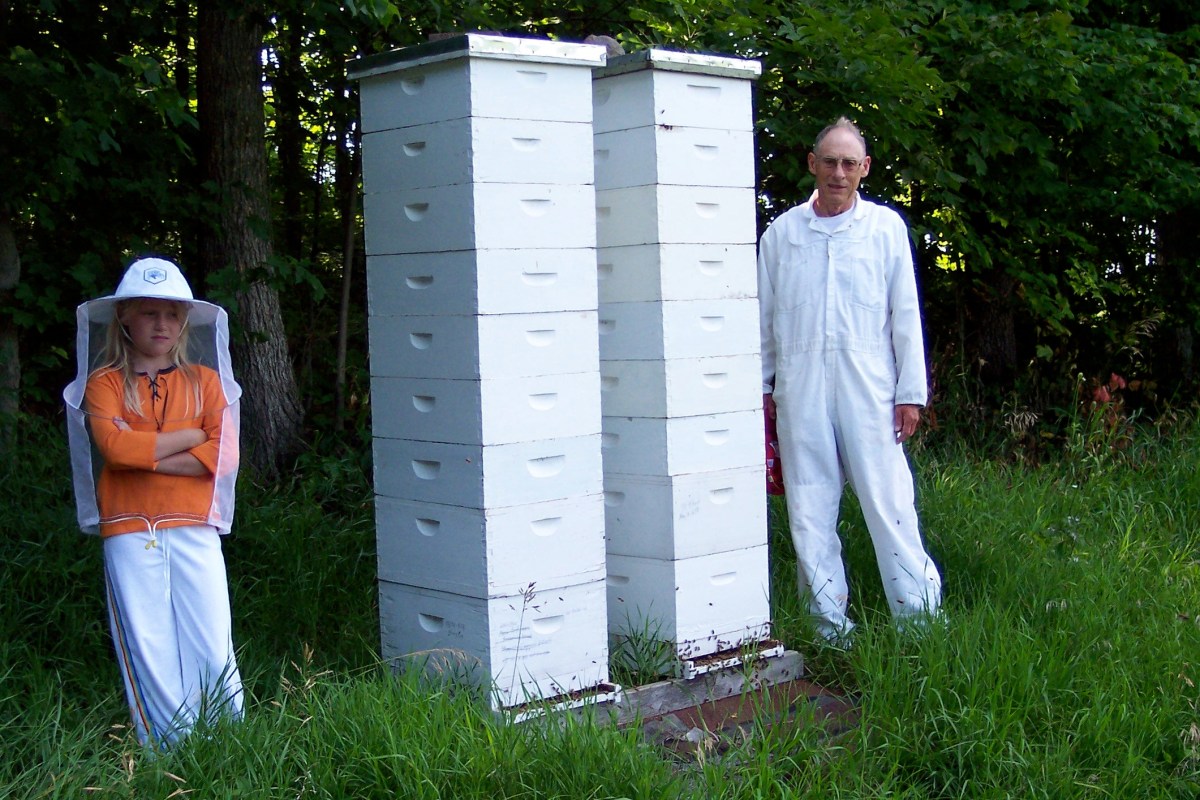
He has no trouble remembering his best colonies, two “boomers” in the late 1980s. He pulled out a framed photo of him and his granddaughter Jessica with two towering colonies between them – each with seven boxes of honey. The photo was taken in the early 2000s.
Thirty years ago, beekeepers fought American foulbrood, treating each fall and spring. Now he said it’s “doggone varroa mite” – if in doubt, treat, he advised.
The biggest mistake made by new beekeepers is to not keep watch over their hives. “They spend all this time in class and money for bees, and then they don’t check on the hives,” he said. “You need to give the bees what they need when they need it – like honey supers. I always carried some with me.”
John admits that he kept bees for more than the honey and their pollination services. “I just like bees,” he said, explaining the mysterious passion that many beekeepers feel once they get hooked. “Think of the wonders you will see if you keep bees. It is marvelous.”
We couldn’t agree more! Thanks for fueling that passion for us and many others!
Iowa Honey Producers Association web site
Central Iowa Beekeepers Association web site
 Bee Lady Honey