BeeHotel.com

FOR RENT: One exquisite suite, plenty of room for all of your family and friends. Some of the best accommodations you will find anywhere, at least within five miles, and at a price you can afford. Available now!

If only bees could read. That’s the advertisement I would send them because we officially are in the bee hotel business.

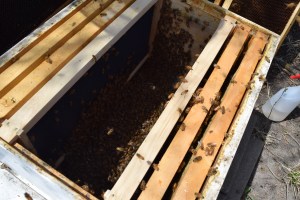
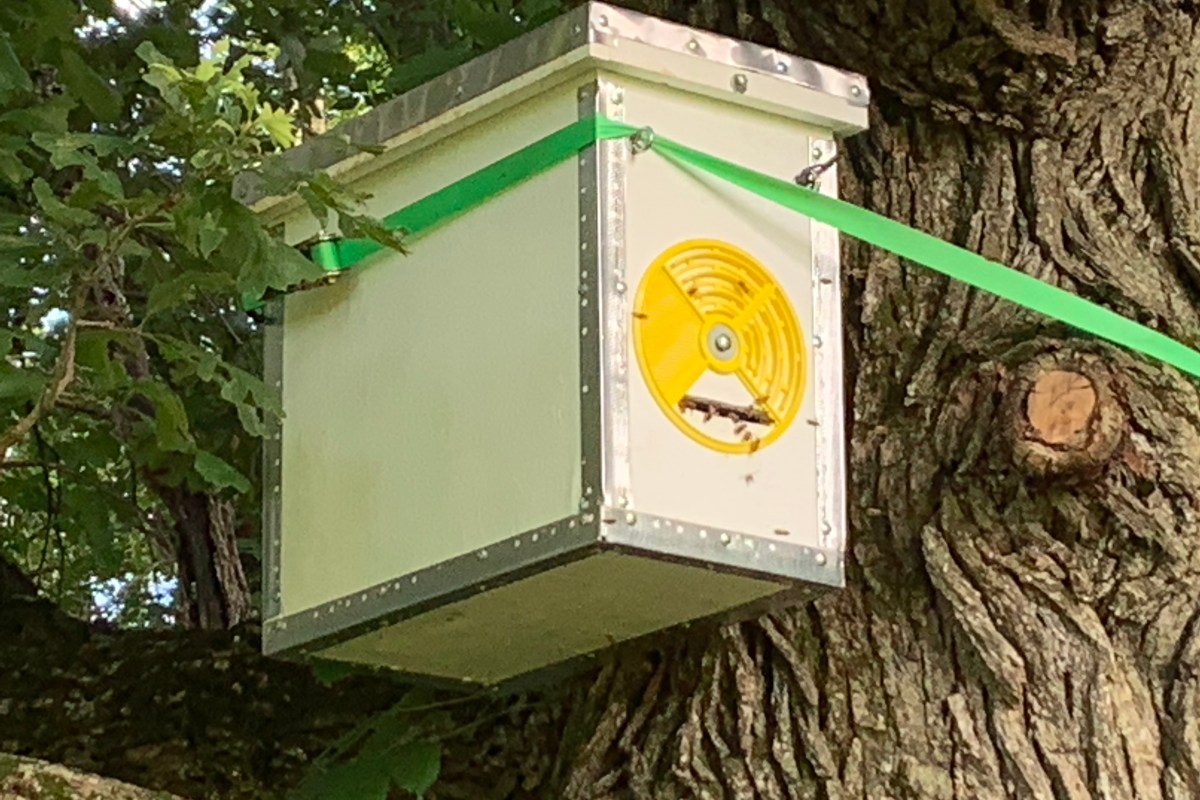
Actually, the white box hung about 12 feet up in one of our towering oak trees is a swarm trap, designed to appeal to errant bees looking for a new hive to call home. Healthy bee hives swarm at least once a year. It’s natural. It’s what they do. It’s how they reproduce.

And to the beekeeper who is able to corral them, a swarm means one thing: free bees!

We hope to capture a swarm – a new hive consisting of worker bees, field bees and a queen laying eggs – in a white wooden box called a swarm box or bait hive.

We learned this technique earlier this year from beekeeper friend and apiary enthusiast Jamie Beyer. He got into swarm trapping in 2018 and has captured more than a dozen swarms, including three swarms in one day this month. He has numerous bait hives placed strategically next to apiaries and woodlands where swarm are most likely to congregate.

Husband Dave built the swarm box last winter according to specific instructions outlined by a Missouri professor Leo Sharashkin. It is based on the behavior of scout bees who are always looking for new spots to take swarms should they form.

Research has shown that scout bees actually measure the space inside a rotten tree or potential hive site by walking the perimeter. From those studies and observations of where swarms actually end up, Sharashkin outlines specifics for a swarm trap: size of box, size of entrance opening, height to hang, etc.
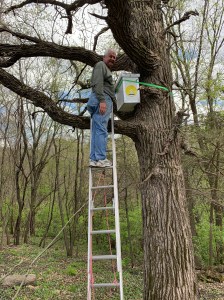
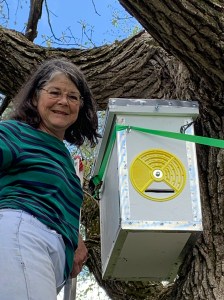
To make it more appealing, we also put 2 frames of empty comb in the box, five frames of new foundation, a little bit of lemongrass oil, and propolis from one of our existing hives.

We identified a large oak tree on the edge of our woods that would be easy to see. Then Dave climbed a ladder and hung this lightweight box from a wire on a screw placed in the tree trunk. He used a nylon packing strap to secure it to trunk. The box needs to be light because when it’s full if bees it could weigh 50 pounds of more.

Now all we have to do is wait for the bees to find our new bee hotel.

More to come, I hope!

Link to Website of Ozark beekeeper Dr. Leo Sharashkin and how to build a swarm trap


Meet a mentor extraordinaire

John Johnson did not have time for honey bees while growing up on his family’s central Iowa farm in Marshall County. “They were mean and they stung me all the time,” he recalls.

But now, after more than 45 years of keeping honey bees and mentoring dozens if not hundreds of new beekeepers throughout Iowa, John’s biggest wonder is “why in the heck can’t I keep on doing this?”

This has been the first spring that John hasn’t donned his white suit on an almost daily basis to check his bees. At 87, health problems have forced John to hang up his smoker and sell a trailer-load of beekeeping equipment. The frames, tools, hives and even honey brought more than $1,800 for the Central Iowa Beekeepers Association (CIBA) at a recent auction – all going to the organization. That’s the kind of person he is, generous with his time and vast knowledge of beekeeping.

I was one of the many “newbies” John mentored during more than four decades of beekeeping. He patiently answered my questions and would drive to my house in the country to help me capture a swarm or figure out a problem with my bees.

In March, CIBA honored John and his wife Elaine for their work with the organization and promotion of beekeeping. A year earlier, the Iowa Honey Producers Association presented him with their prestigious Pioneer Award. Johnson served as IHPA president from 1989-1991, when the Iowa Honey Queen program was adopted and about the time that the group introduced its popular honey lemonade at the Iowa State Fair.

A few days ago, my husband Dave and I visited John and Elaine to hear a few highlights of his long beekeeping career and see what advice he wanted to offer. We knew he would be thorough and meticulous – our bee notebook is full of John’s typed notes and we have spent more than a few hours listening to his lessons.

Given the “mean bees” on his family’s farm, how did he get back to tending his own bees? It was about 1974 and John was area extension director in northern Iowa. The Clay County office needed help setting up for a program by the state apiarist. “I guess I got interested and ended up taking the beekeeping course myself,” John said. He got two colonies of bees from his brother-in-law and that was it: bit by the bee bug.

Day-to-day details of keeping bees can be really confusing, and like other newcomers, John relied on help from established beekeepers to learn the ropes. A few years later, he moved to Ames to take a state-level extension job at ISU. The first thing he did was look for bee mentors.

“I couldn’t find anything going on in Story County and I couldn’t believe it,” he said. He offered to teach a class at McFarland Park with the Story County Conservation Board. “They were all for it,” he said. “We expected about 10 people but 36 showed up. It was one of the most pleasant classes I taught.”

Interest grew quickly. John taught in Des Moines and began to take new beekeepers under his wing. His apiary also expanded. At one point he tended 70 hives, selling at several farmers markets, even wholesale the year he had 10 barrels of honey in his garage. It was common to get 120 pounds from each colony.

“But the world for bees and beekeepers has really changed since then,” John lamented. Among the most drastic is habitat loss.

“Many of the flowers and trees they depend on for pollen and nectar are not there anymore,” John said. “Think of white Dutch clover; our lawns used to be filled with them, and all those hayfields and fence rows are gone. This is serious stuff.”

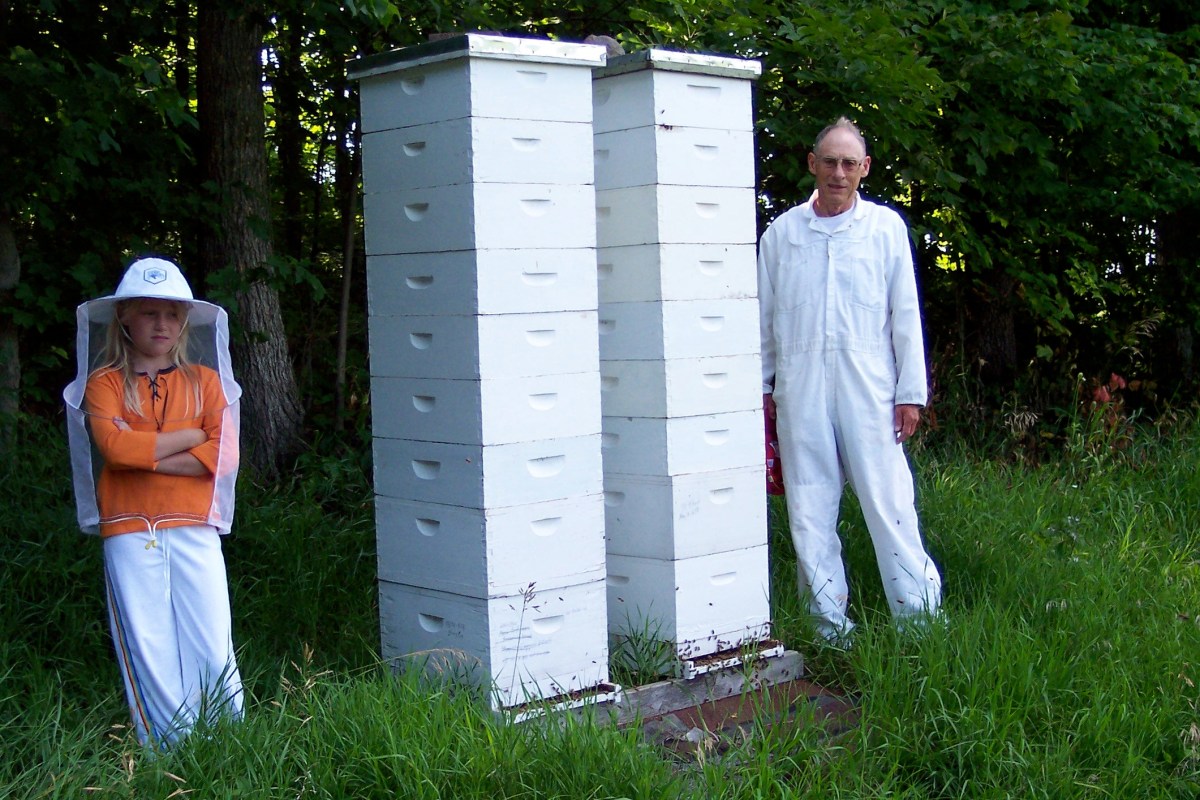
He has no trouble remembering his best colonies, two “boomers” in the late 1980s. He pulled out a framed photo of him and his granddaughter Jessica with two towering colonies between them – each with seven boxes of honey. The photo was taken in the early 2000s.

Thirty years ago, beekeepers fought American foulbrood, treating each fall and spring. Now he said it’s “doggone varroa mite” – if in doubt, treat, he advised.

The biggest mistake made by new beekeepers is to not keep watch over their hives. “They spend all this time in class and money for bees, and then they don’t check on the hives,” he said. “You need to give the bees what they need when they need it – like honey supers. I always carried some with me.”

John admits that he kept bees for more than the honey and their pollination services. “I just like bees,” he said, explaining the mysterious passion that many beekeepers feel once they get hooked. “Think of the wonders you will see if you keep bees. It is marvelous.”

We couldn’t agree more! Thanks for fueling that passion for us and many others!

Iowa Honey Producers Association web site

Central Iowa Beekeepers Association web site


House guest

My bees always, always surprise me. And this week they gave me one of the biggest surprises yet. It was a little embarrassing but I’ll share it anyway.

As you may recall, I have been tending to three new hives, each with a new queen bee. They came from California (I apologize for this cool Iowa spring), and I have been hoping that these new gals have been adjusting well to their new home.

So on Friday I checked all the hives. My long-time mentor John Johnson always told me that the main purpose of a hive check is to make sure they are “queen-right,” that is, they have a working queen. Since the queen’s only job in the hive is to lay eggs, you look for eggs or baby bee larva.

The fIrst new hive looked good. I found lots of bees crawling over cells filled with larvae. A strong queen will fill nearly every cell on a frame. A weaker queen will leave gaps, which isn’t as good, but one only hopes she’ll get better at her job.

The second hive looked good, too. Lots of larva waiting to be fed by the nurse bees.

But the third hive was different. No new comb, no cleaning up old comb. Lots of bees, but they didn’t seem to be doing much of anything. Then I spotted the queen (luckily, she was marked with a bright green dot on her thorax). She was crawling around on an empty frame.

Not good a good sign.

I called my bee supplier, Connie, from Perry. “I think my queen is bad,” I told her. “There aren’t any eggs or larva in the hive. I don’t think she’s Doug her job.”

Sometimes queens do not perform adequately. Virgin queens are fertile for only a few days after they emerge from their cell. They mate only during their lifetime, and poor flying weather and lack of mates can greatly impact their laying capacity for the rest of their lives. That may have been the case with my queen.

Connie quickly offered to replace the queen. I only needed to pick her up. So the next day off I went to Connie’s shop.

Soon I was back in the hive. I had plenty of mixed emotions about finding – and killing – the “bad” queen before slipping in her replacement.

Out came a frame and I couldn’t believe what I saw: cells full of tiny, white bee larva!

I looked again. Sure enough! The queen was alive and well! The hive was queen-right!

How could I have missed that, I wondered. Red-faced, I called Connie. “Uh, I have bad news. There was a lot of larva in my hive, so I am not replacing my queen,” I told Connie.

“But that’s good news!” she replied.

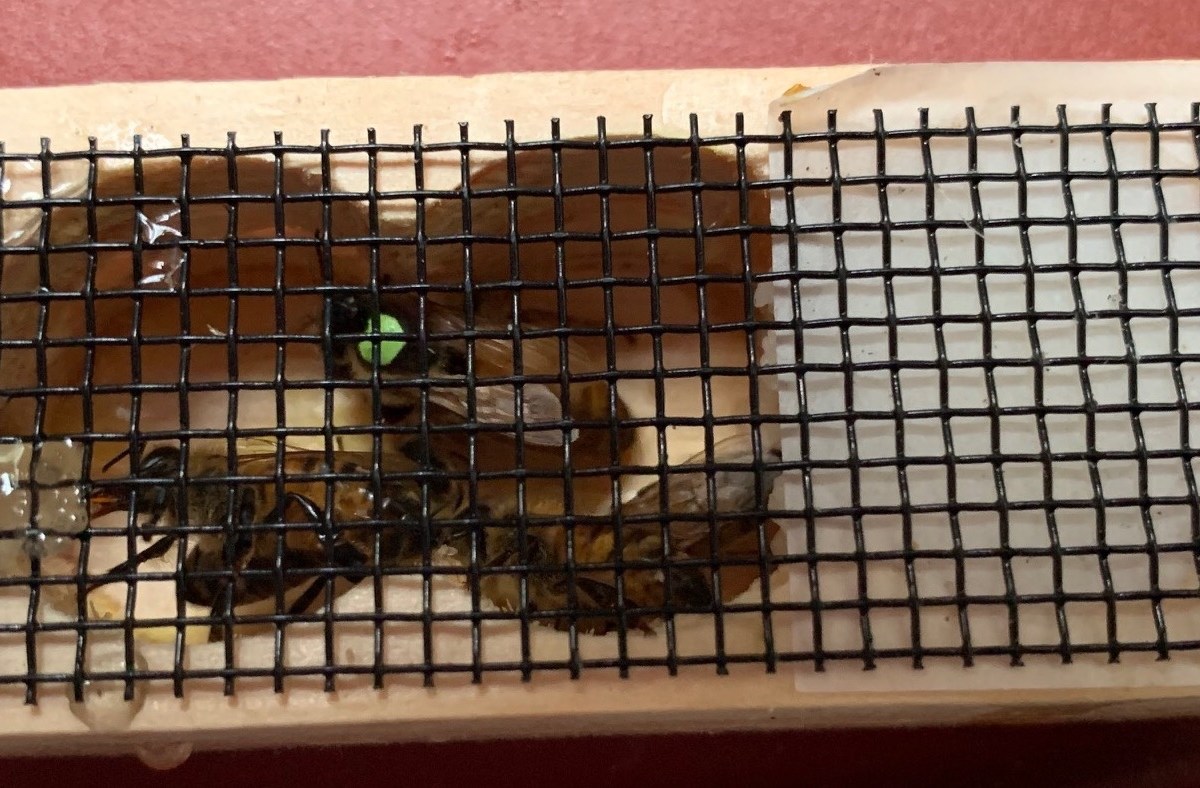
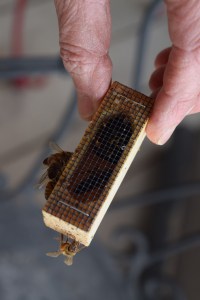
It turns out that Connie can pick up the queen in a few days when she’s in the area. The new queen I have is in a tiny cage, along with f our “attendant” bees. They will make sure she is fed, watered and generally pampered.

All I need to provide for my new house guest is a drop of water and a drop of honey three times a day. Let’s hope the queen enjoys her stay and can bring life to another hive.

Queen in a cage. The attendant is on the bottom, outside the cage.
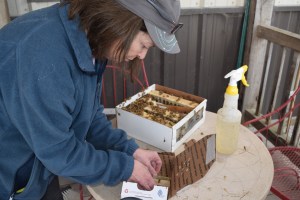
The queen’s cage is placed in the middle of the hive. A candy plug, which the bees slowly remove, keeps the queen in the cage for few days.
Connie gets a queen, shipped to Iowa from California.