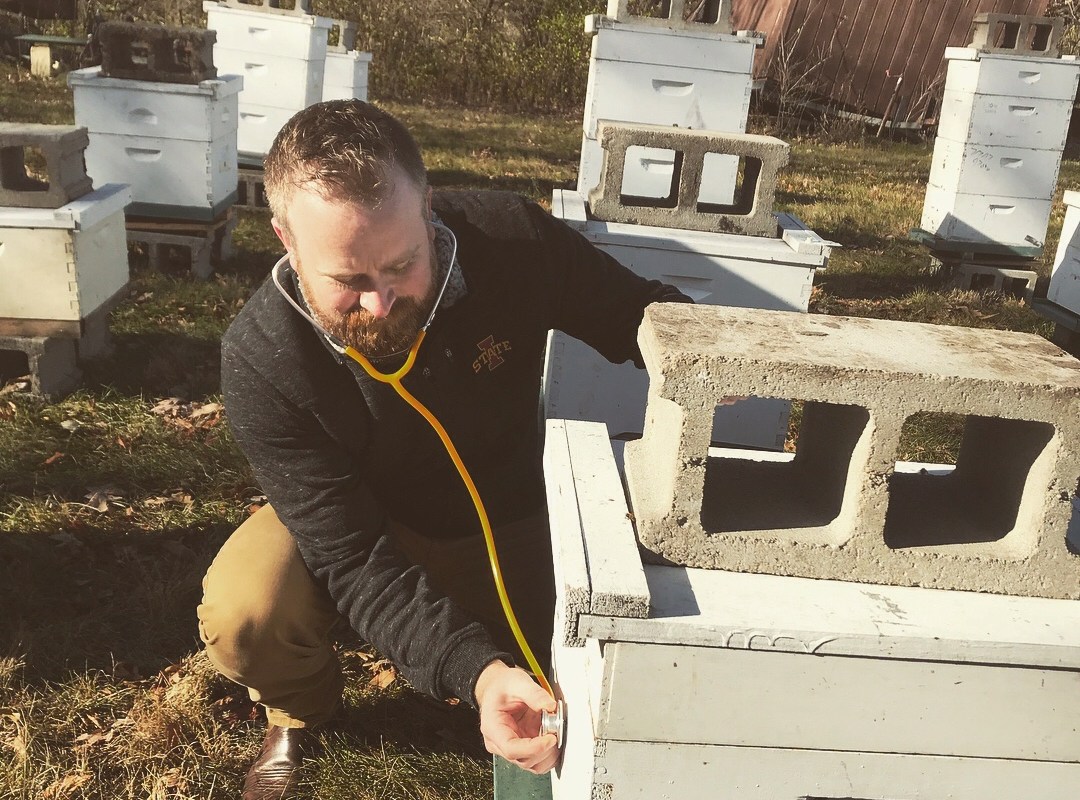
Beekeepers have a new guy to answer our questions: Randall Cass is the new Extension entomologist at Iowa State University. His area of expertise is honeybees, native bees and pollinators.
I had the pleasure of meeting Cass recently at a winter seminar in Grimes hosted by the Central Iowa Beekeepers Association. He has a master’s degree in International Agricultural Development from the University of California Davis. His most recent work was in El Salvador, helping a group of new beekeepers form a cooperative to improve their honey production on a shoestring budget. He also has worked with beekeepers in Chile, Ghana and Guatemala.
One of the first things the group did was to create calendars, mapping the major flowering periods in the region so they would know when to provide supplemental feed for their bees. Even in a tropical region, the bees experience a dearth of nectar and benefit from sugar water.
Other calendars plotted various activities during the year: when to look for swarms, when to treat for disease and when to extract honey. They also met monthly to talk about beekeeping and learn from other, more experienced beekeepers.
Hey, that’s what we do in Iowa! I learn the most from other expert beekeepers, and try to stay active in local beekeeping groups.
After a year, the cooperative grew from six people with eight rustic hives (simple wooden boxes made from scrap lumber) to 11 people with 20 hives, including a number of modern Langstroth hives.
In Iowa, Cass is part of a team that is studying pollinator health in a typical Iowa landscape dominated by corn and soybeans, and also complex landscapes, such as prairie, that have a diversity of forage species. They found that hive mass was greater in simple landscapes until a critical period in late July and August when nectar sources became scarce. Moving hives to a complex (prairie) landscape could actually help bees build up food stores before winter, he said.
Cass outlined three lessons for Iowa beekeepers from his international experiences:
- Check hives regularly.
- Know where bees get food and that they have enough food.
- Communicate with neighboring farmers and register hives with FieldWatch, a fairly new registration for apiaries that is monitored by pesticide applicators.
 I’m looking forward to hearing more from Randall Cass. He has an Instagram account at iowastatebees, and is part of the ISU Pollinator Conservation Working Group.
Here’s a link to an interesting article in a United Kingdom science magazine, The Whole Food Diet for Bees. At the end, the author discusses research that Cass mentioned in his presentation.
More about the National FieldWatch program and how it is used at the Iowa Department of Agriculture and Land Stewardship
Link to the ISU Pollinator Conservation Working Group
Many thanks to Cass for the photo. Above, he is is trying the “knock test” to monitor hive vitality. This involves giving each hive a firm knock and listening for an audible buzzing reaction using a stethoscope. This method could help monitor colony strength in winter without having to open the hive and expose the bees to the cold.
 Bee Lady Honey