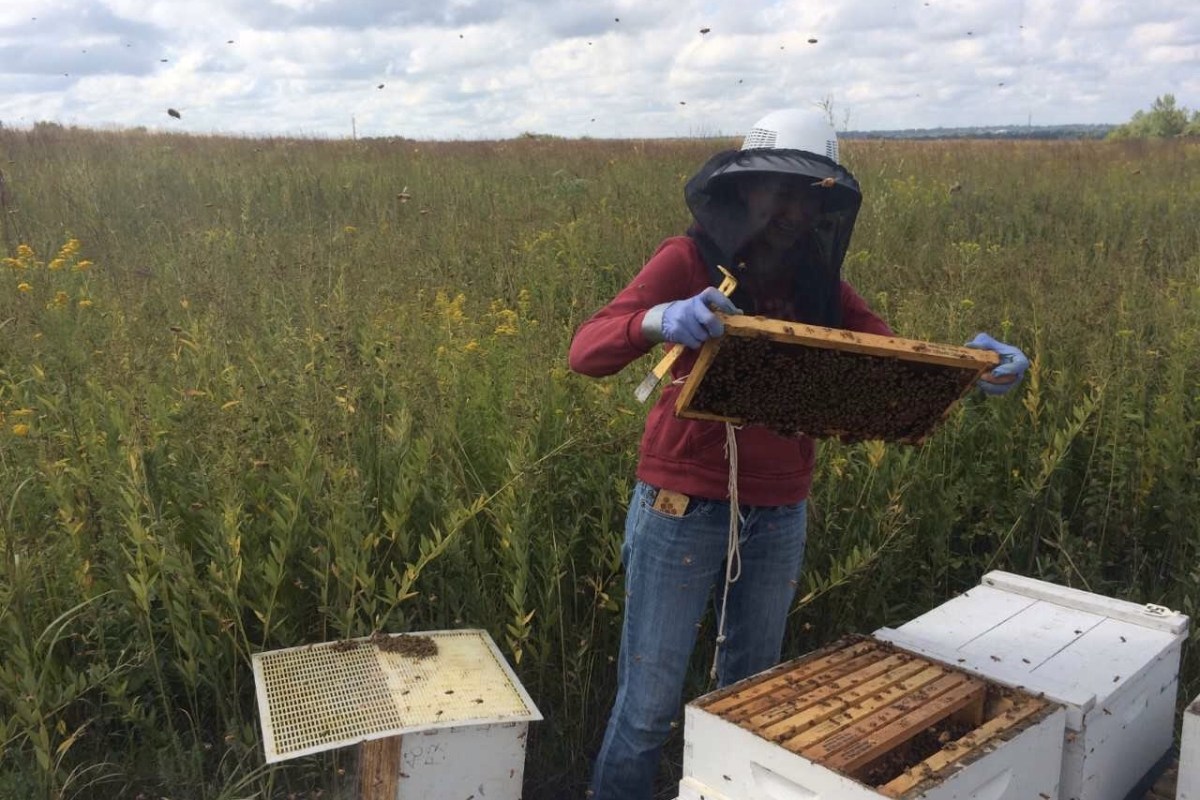
Honeybees are tiny creatures that have been fighting some big things in recent years. Sometimes called the three Ps, these “big things” are poor nutrition and habitat, exposure to pesticides and other toxins in the environment, and pests and other pathogens. Together they spell big trouble for the honeybee.
I learned more about their plight recently at a winter seminar hosted by the Central Iowa Beekeepers Association. We heard from Dr. Amy Toth, an associate professor at Iowa State University who leads a team of researchers at the Toth Laboratory of Integrative Insect Sociobiology (her Bee Lab). She shared results of a new study on bee behavior related to parasites and pathogens.
In bee-land, the leading parasite is the varroa mite. While the mite itself can kill a colony of bees in one or two seasons, varroa mites also host more than 20 common viruses. These viruses affect bees in all sorts of ways – from deforming wings, killing queen larvae and even complete paralysis.
Toth said they were interested in how viruses spread within the hive and from hive to hive, and whether the virus causes changes in bee behavior that might be an advantage to the pathogen itself. The team isolated one pathogen, the Isaraeli acute paralysis virus, infected bees with a sub-lethal amount, then recorded certain aspects of bee behavior.
They found that non-infected bees tended to isolate their infected sisters, which would help stem the spread of the virus, and that the sick bees tended to leave the hive and not return, which also could be good for the health of the hive. However, sick bees also moved more around the hive infecting food stores, and when they tried to enter another hive were more likely to be accepted by the guard bees.
Toth said the team suspected that the virus could change how a sick bee smells to its nestmates and other bees. Similar behaviors have been found in research at Michigan State University, she said, among bees infected with the nosema parasite.
“This research shows that there is an ongoing evolutionary arms race between bees and these pathogens, it’s always changing,” Toth said. “Common apiary diseases, even if not killing bees, may be changing bee behavior to the pathogen’s advantage.”
 The research was funded in part by the U.S. Department of Agriculture and a small grant from the Iowa Honey Producers Association.
Here is a link to Dr. Toth’s Bee Lab at Iowa State
Thanks to Iowa State for the photos on this page.
 Bee Lady Honey